CNC Latest Jaali Cutting Ideas: What File Format Is Required for CNC Cutting?

If you are planning a custom CNC jaali design for your home, office, mandir, partition, door, or building facade, one important question comes before cutting begins: What File Format Is Required for CNC Cutting? A properly prepared digital design file helps the CNC machine understand the exact shape, dimensions, curves, holes, and cutting paths required for your project.
Today, CNC cutting technology allows architects, interior designers, homeowners, and fabricators to create highly detailed CNC jaali cutting designs in MDF, HDHMR, WPC, acrylic, plywood, natural wood, ACP and other suitable materials. From traditional floral patterns to modern geometric screens, the latest CNC jaali ideas can transform an ordinary space into a distinctive architectural feature.
What File Format Is Required for CNC Cutting?
For CNC cutting, the most commonly used file formats are DXF, DWG, AI, SVG, and CDR, depending on the CNC machine, design software, and fabrication workflow.
Among these, DXF (Drawing Exchange Format) is one of the most widely used formats for CNC cutting because it can contain vector-based geometry that CNC software can convert into toolpaths.
Common CNC file formats
File Format | Common Use | CNC Suitability |
DXF | CNC cutting and 2D vector drawings | Excellent |
DWG | CAD drawings and architectural designs | Excellent |
AI | Vector artwork and graphic designs | Good |
SVG | Vector designs and patterns | Good |
CDR | CorelDRAW vector designs | Good |
Reference or vector artwork | Depends on file | |
JPG/PNG | Reference images | Not directly suitable for cutting |
A JPG or PNG image alone is generally not a proper CNC cutting file because it contains pixels rather than editable cutting paths. If you have a reference image of a jaali pattern, it may first need to be converted or redrawn as a vector/CAD file.
Why the Correct CNC File Format Matters
CNC machines work according to digital geometry and toolpaths. The cutting software needs to know exactly where the machine should move.
A properly prepared file can define:
Overall panel dimensions
Outer cutting boundary
Internal jaali pattern
Holes and openings
Curves and straight lines
Engraving areas
Cutting depth
Design scale
Material thickness
For intricate CNC jaali cutting, even a small error in the design can affect the final result. Open curves, overlapping lines, duplicate vectors, incorrect dimensions, or extremely thin sections can create cutting problems.
This is why a clean vector or CAD file is an important part of the CNC fabrication process.
Latest CNC Jaali Cutting Ideas for Modern Interiors
CNC jaali designs have evolved significantly. Modern designs combine traditional Indian patterns with contemporary geometric forms, making them suitable for both residential and commercial interiors.
1. Geometric CNC Jaali Partitions
Geometric jaali patterns featuring diamonds, hexagons, squares, circles, and intersecting lines are popular for modern living rooms and dining areas.
A CNC-cut geometric partition can separate two spaces without completely blocking light or visibility. Adding a wooden or walnut finish can create a premium architectural appearance.

2. Floral and Botanical CNC Jaali Designs
Floral jaali patterns remain popular because they add a decorative and traditional character to interiors. Modern CNC technology can reproduce detailed leaves, vines, flowers, and botanical motifs with consistent precision.
These designs work especially well as feature walls, room dividers, cabinet panels, and decorative screens.

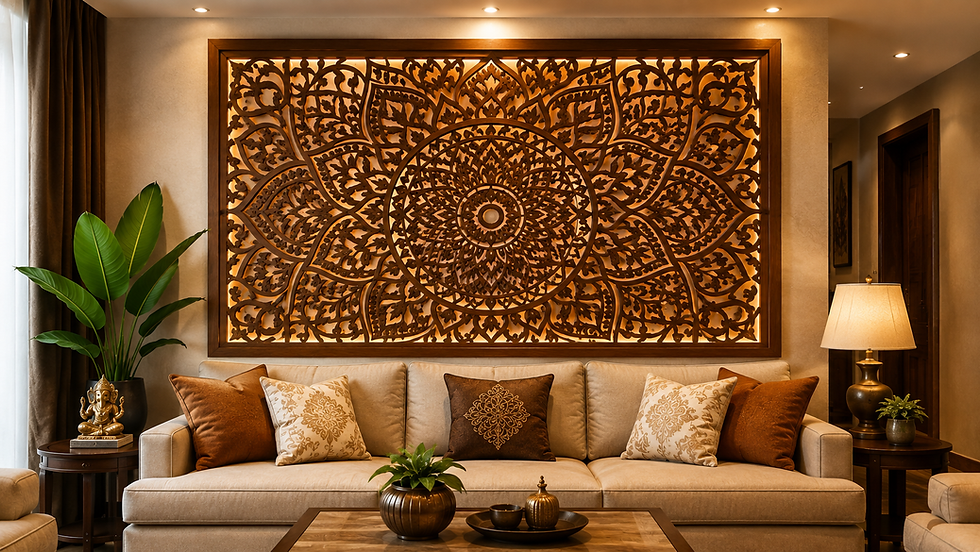
3. Backlit CNC Jaali Feature Walls
One of the latest interior trends is combining CNC jaali panels with LED lighting. A patterned panel installed in front of warm LED lights creates depth and attractive shadows.
Backlit jaali panels can be used behind sofas, beds, reception desks, TV units, and mandir areas.
The effect becomes even more impressive when the design has different levels of depth or a carefully selected pattern density.
4. CNC Jaali for Home Mandirs
CNC cutting is also ideal for creating customized mandir jaali panels. Lotus motifs, Om symbols, temple arches, bells, and traditional floral patterns can be incorporated into the design.
A CNC-cut mandir backdrop can be combined with warm LED lighting, brass elements, and wooden finishes for a traditional yet contemporary appearance.

5. CNC Jaali for Doors and Entryways
CNC-cut patterns can also be incorporated into wooden doors and entrance screens. Minimal geometric bands, floral carvings, and traditional Indian motifs can create a customized entrance.
For a premium appearance, the CNC pattern can be combined with natural wood grains, contrasting finishes, or metal elements.

6. WPC CNC Jaali Panels
WPC is another popular material for decorative CNC jaali applications. It can be used for partitions, wall panels, decorative screens, and selected exterior applications depending on the product specification and installation conditions.
The advantage of choosing different materials is that the same CNC pattern can produce completely different visual results.
For example, a geometric design can have a warm wooden appearance in MDF or natural wood, while a WPC version can provide a more contemporary decorative finish.
How to Prepare a CNC Jaali Cutting File
Before sending a design for fabrication, check the following:
Use the correct scale – The design should match the required final dimensions.
Convert artwork into vector paths – Raster images need to be converted or redrawn.
Close all cutting paths – Open vectors can cause problems during toolpath generation.
Remove duplicate lines – Overlapping vectors can result in repeated cutting.
Check minimum thickness – Extremely thin sections may break during machining.
Separate cutting and engraving elements – Different operations may require different toolpaths.
Confirm material thickness – Tool selection and cutting depth depend on the material.
Add dimensions – Clearly mention the required width and height of the final panel.
For custom projects, you can provide a CAD drawing, vector file, reference image, or design concept to a CNC fabrication professional. The design can then be checked and prepared according to the material and machine requirements.
Can a Reference Image Be Used for CNC Cutting?
Yes, a reference image can be used as the starting point for a CNC jaali design, but a normal JPG or PNG image is usually not directly ready for CNC cutting.
For example, if you find an interesting jaali design online or have a photograph of an existing panel, the pattern can be recreated as a vector or CAD drawing. The final file can then be prepared for CNC cutting.
This approach is particularly useful when customers want a custom CNC jaali design based on a reference photo rather than selecting a standard pattern.
Custom CNC Jaali Cutting in Dehradun
At Crafts N Creations, we create customized CNC carving and cutting solutions for residential and commercial projects. Our fabrication work includes CNC jaali panels, decorative partitions, mandir panels, backlit panels, facade elements, door panels, and custom architectural designs.
We work with materials such as MDF, HDHMR, WPC, acrylic, ACP, and natural wood, depending on the project requirements.
Whether you have a ready CAD file or only a reference image, a customized CNC design can be developed according to the required size, material, pattern, and application.
Final Thoughts
Understanding what file format is required for CNC cutting is an important step when planning a customized jaali project. DXF and DWG are commonly preferred for CAD-based CNC work, while AI, SVG, and CDR can also be useful depending on the fabrication workflow.
At the same time, the latest CNC jaali cutting ideas offer far more possibilities than traditional decorative screens. Geometric partitions, botanical panels, backlit feature walls, mandir designs, WPC screens, and customized entrance panels can all be produced with precision CNC technology.
The key is to start with a clean, correctly scaled vector or CAD design and select the right material and cutting method for the application. A well-prepared file helps turn a creative jaali concept into a precise, high-quality finished panel.
Feel Free to ask Anything?
Pick a number from the list above, or send a reference photo, and the team will quote material, size, and turnaround.
📞 8755252567
📍 Crafts N Creations, Near Ambiwala Gurudwara, Danda Dharampur, Dehradun – 248001


Comments